

Glöckner Von Notre Dame Berlin Cast
| Der Glöckner von Notre Dame | |
|---|---|
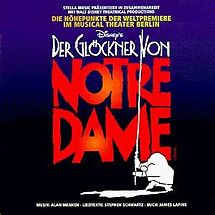 Original cast recording, comprehend art | |
| Music | Alan Menken |
| Lyrics | Stephen Schwartz |
| Volume | James Lapine |
| Ground | Disney motion-picture show The Hunchback of Notre Matriarch |
| Productions | 1999 Berlin |
Der Glöckner von Notre Matriarch (literally translated in English, The Bellringer of Notre Dame) is a musical with music by Alan Menken, lyrics past Stephen Schwartz, and volume past James Lapine. The musical is based on the 1996 Disney film, The Hunchback of Notre Dame, which was inspired by the 1831 Victor Hugo novel of the same proper name.
The musical premiered in 1999 in Berlin, Frg, produced by Walt Disney Theatrical, the visitor's first musical to premiere outside the U.S. It ran for three years, condign one of Berlin'southward longest-running musicals.
Contents
- 1 Production
- 1.1 Possible U.South. version
- 2 Synopsis
- 3 Musical numbers
- 4 Roles and original Berlin cast
- five Differences from the original 1996 film
- 6 Pattern features
- seven Reception
- 8 References
- 9 External links
Product
The musical opened on June 5, 1999, for the opening of the Musicaltheater Berlin (today Theater am Potsdamer Platz), Berlin. [i] After a successful run, it closed in June 2002. [ii] Directed by Lapine, the German translation was by Michael Kunze, choreography by Lar Lubovitch, prepare design by Heidi Ettinger, costume pattern past Sue Blane, lighting past Rick Fisher, audio by Tony Meola and projections by Jerome Sirlin. [3] [4] [five]
This was Disney's first musical to premiere exterior the Us, [2] and it became one of Berlin's longest-running musicals to date. As with Beauty and the Beast and The Lion King, Der Glöckner Von Notre Dame opened three years after the release of the movie it is based on.
The musical is a darker, more gothic accommodation of the film. According to translator Michael Kunze, he was " 'campaigning to permit Esmeralda to die at the end, equally she does in the volume. In that location was a feeling that the audience would be depressed if Esmeralda dies. I feel that a European audience would see this as a very romantic ending ... two lost souls finally find each other. People volition weep, but they'll be moved. And information technology is a very romantic catastrophe.' " [6] The producers wanted to see how "preview audiences react earlier making the last decision." [6]
An original bandage recording was recorded in German. [7]
Possible U.Southward. version
In 2008, Stephen Schwartz said, "I think we're starting up Hunchback of Notre Dame, hopefully, next year [2009]." [8] In a November 2010 interview, Alan Menken confirmed that he was working on an American production: "Nosotros're bringing that ane back, also! ... nosotros are still using James Lapine'southward book." [9]
Synopsis
- Act I
In medieval Paris, Clopin, an old gypsy beggar, sings of the bells of the Cathedral of Notre Matriarch ("The Bells of Notre Matriarch"), and almost how the bellringer was adopted by the Government minister of Justice, Claude Frollo. Frollo and his men notice gypsies sneaking into the city. Thinking i of the gypsies has a bundle of stolen goods, Frollo chases her to Notre Dame, where he snatches the bundle and kills the gypsy. When Frollo discovers it is a plain-featured child, he attempts to kill it, merely he is stopped by the Archdeacon. He tells Frollo to prefer the kid in lodge to save his soul from eternal damnation for murdering the woman exterior of the cathedral. Frollo accepts, on the condition that the kid live in the cathedral'due south bell belfry to keep him abroad from the outside world.
Xx years after, the boy, named Quasimodo, is the bell ringer of Notre Dame and has grown into an adult. 1 mean solar day he notices that Parisians are preparing for the annual Festival of Fools. The three gargoyles, Antoine, Charles and Loni, encourage him to attend the festival, although he has never ventured outside Notre Dame. Frollo arrives and forbids Quasimodo to leave the belfry, while the gargoyles urge him to disobey and venture out ("Sanctuary"). After Frollo leaves, Quasimodo decides to become out for just one day ("Out There").
While the Parisians proceed their preparations, Clopin, Rex of the Gypsies, prepares his gypsies for the festival at their undercover hide-out, the Courtroom of Miracles ("Balancing Act"). Their attention is taken by a newcomer, a young gypsy dancer named Esmeralda. Meanwhile, Captain Phoebus arrives in Paris excited about his new promotion every bit Captain of the Guard ("Balance and Recreation"). He flirts with a immature girl merely is suddenly interrupted past a fleeing gypsy defendant of theft. The gypsy pleads innocence but Frollo arrives and orders his soldiers to arrest the gypsy. Frollo tells Phoebus that the city has become over-run by Gypsies and that he plans to find the Courtroom of Miracles and eliminate them all.
Every bit the Festival begins ("Topsy Turvy"), Quasimodo arrives in disguise so Frollo volition not recognize him. Frollo crosses paths with Esmeralda while dancing for the crowd. Afterwards, people brainstorm to audition for the King of Fools. Thinking Quasimodo is in costume, Esmeralda pulls Quasimodo onstage and the crowd crowns Quasimodo every bit their king. Only Quasimodo's identity is revealed and the crowd starts a riot, with Frollo refusing to call it off. Esmeralda intervenes and openly insults Frollo for his cruelty. Esmeralda comes to Quasimodo's rescue and Frollo orders Phoebus to arrest her but Esmeralda disappears. Quasimodo returns to the bell belfry, ashamed and humiliated.
Esmeralda follows Quasimodo but Phoebus catches her inside the cathederal. Frollo arrives and interrogates her but the Archdeacon orders Frollo to leave, because those in the cathedral are protected by the law of sanctuary. Esmeralda prays for her people and the down-trodden ("God Help the Outcast"). Meanwhile, Frollo orders Phoebus to mail service a guard at every door to ensure that Esmeralda does not escape.
Esmeralda follows Quasimodo to the bell tower and is captivated by the view of the city ("On Summit of the World"). To repay Esmeralda for rescuing him, Quasimodo offers to show her a way out of the cathedral. Before leaving, Esmeralda gives him an amulet leading to the Courtroom of Miracles should he ever need to find her, and she likewise kisses him on the cheek. After Esmeralda leaves, Quasimodo expresses his feelings, as he has been touched by Esmeralda's kindness ("Heaven'southward Low-cal"). Frollo fears eternal damnation considering of his own affections for Esmeralda and plans to execute her if she will not be his ("Hellfire").
The side by side morning, Frollo sees that Esmeralda is gone and asks Quasimodo where she is. Quasimodo says he does non know and Frollo organizes a manhunt to find Esmerelda. Phoebus somewhen defies Frollo's order to burn down a house with a family unit inside, believing that they gave Esmeralda shelter. Frollo and his men begin to search the city ("Esmeralda"). Phoebus is defenseless crossing a bridge and shot in the arm with an arrow. He collapses into the river below simply Esmeralda rescues her.
- Deed II
The soldiers keep searching the city ("City Nether Siege"). Esmeralda rescues Phoebus and tells him to seek sanctuary at Notre Dame while she returns to the Court of Miracles. Meanwhile, the gargoyles convince Quasimodo that Esmeralda finds him romantically intriguing, and they reassure him about her safe ("A Guy Similar You"). The Archdeacon brings Pheobus to the bong tower and Phoebus, knowing Quasimodo to exist a friend of Esmeralda's, asks Quasimodo to hide him.
Frollo returns and discovers that Quasimodo helped Esmeralda escape afterwards request him. Frollo tells Quasimodo that he knows where the Courtroom of Miracles is and intends to assault at dawn. Afterward Frollo leaves, Phoebus comes out of hiding and asks Quasimodo to help him find the Court of Miracles and warn Esmeralda. Quasimodo refuses to leave the cathederal again but Phoebus and the gargoyles teach Quasimodo the value of devotion and selflessness ("Out of Love").
Using Esmeralda'south amulet as their guide, Quasimodo and Pheobus detect the Court of Miracles. The gypsies assume them to exist Frollo's spies merely Esmeralda assures them the 2 men are friends. Phoebus tells the gypsies about Frollo'south programme and Clopin orders the gypsies to fix to leave. Esmeralda and Pheobus decide to leave the city together while Quasimodo, heartbroken, watches Esmeralda leave with the human being she truly loves ("Out of Dearest" (Reprise)). All the same, Frollo has followed them to the Court of Miracles and orders Esmeralda and Pheobus arrested, and Quasimodo imprisoned in the bell belfry.
Frollo offers Esmeralda freedom if she will get his but Esmeralda refuses. The gargoyles tell Quasimodo to rescue Esmeralda but Quasimodo, feeling aroused and defeated, tells them he is never going to the outside earth and to leave him lone ("Made of Stone"). Equally dawn approaches, Esmeralda awaits her execution in the dungeon with Phoebus hoping that one twenty-four hours the globe will be a better place ("Someday").
Frollo prepares to burn Esmeralda at the pale and offers her a chance to apologize, but Esmerelda refuses and his men light the fire. Unable to conduct the sight of Esmeralda in danger, Quasimodo swings down to the foursquare and carries Esmeralda dorsum to the bell tower. Frollo orders his men to break into the cathedral but Phoebus and the Parisians revolt confronting them. Quasimodo calls upon the saints and the gargoyles to cause a molten cascade of lead to fall upon the soldiers. Quasimodo seeks Esmeralda, to tell her of their victory, and that she is now prophylactic. Withal, Esmeralda dies afterwards thanking him for existence a good friend.. Frollo finds Quasimodo grieving over Esmeralda's decease and tries to comfort him but Quasimodo throws Frollo over the balcony to his expiry. The gargoyles comfort Quasimodo and tell him the world is full of good as well as evil. The Parisians sentry as Quasimodo carries Esmeralda's body through the square with Pheobus by his side. Clopin appears again and asks what makes a monster and what makes a man. ("Thousand Finale").
Musical numbers
- Act I [ten]
- "Die Glocken Notre Dames" ("The Bells of Notre Matriarch") – Clopin, Archdeacon, Frollo & Chorus
- "Zuflucht" ("Sanctuary") – Frollo, Quasimodo, Antoine, Charles & Loni
- "Draußen" ("Out There") – Quasimodo
- "Tanz auf dem Seil" ("Balancing Act") – Clopin, Esmeralda & Gypsies
- "Ein bißchen Freude" ("Balance and Recreation") – Phoebus
- "Drunter drüber" ("Topsy Turvy") – Clopin, Quasimodo & Crowd
- "Helf den Verstoß'nen" ("God Assist the Outcasts") – Esmeralda, Quasimodo & Parisians
- "Hoch über der Welt" ("Top of the World") – Esmeralda, Quasimodo, Antoine, Charles & Loni
- "Das Licht des Himmels" ("Heaven'due south Light") – Quasimodo
- "Das Feuer der Hölle" ("Hellfire") – Frollo & Priests
- "Esmeralda" – Frollo, Quasimodo, Phoebus, Esmeralda, Clopin & Soldiers
- Act Ii
- "Trommeln in der Stadt" ("City Nether Siege") – Clopin & Parisians
- "Ein Mann wie du" ("A Guy Similar You") – Antoine, Charles, Loni & Quasimodo
- "Weil du liebst" ("Out of Honey") – Quasimodo, Phoebus, Antoine, Charles & Loni
- "Tanz der Zigeuner" ("Dance of the Gypsies") - Orchestra
- "Weil du liebst ("Out of Dearest (Reprise)") – Phoebus, Esmeralda & Quasimodo
- "Wie aus Stein" ("Fabricated of Stone") – Quasimodo, Loni, Charles & Antoine
- "Einmal" ("Anytime") – Esmeralda, Phoebus & Parisians
- "K Finale" – Total Visitor
Roles and original Berlin cast
Source: Variety Magazine [five]
- Quasimodo: Drew Sarich
- Esmeralda: Judy Weiss
- Phoebus: Fredrik Lycke
- Clopin: Jens Janke
- Frollo: Norbert Lamla
- Charles: Valentin Zahn
- Loni: Yvonne Ritz Andersen
- Antoine: Tamàs Ferkay
- The Archdeacon: Carlo Lauber
Differences from the original 1996 film
- The gargoyles' names have been changed from Victor, Hugo and Laverne to Charles, Antoine and Loni. The gargoyles' comedy in the musical is greatly toned downward; they sing in many more songs, and they are also firmly established equally figments of Quasimodo's imagination.
- Neither Esmeralda's goat Djali nor Phoebus' equus caballus Achilles appear in the stage musical.
- Esmeralda is shown a manner out of Notre Dame rather than Quasimodo climbing down, holding her.
- When narrating, Clopin appears equally a crippled erstwhile beggar and no longer uses puppets.
- The song from the motion picture "The Court of Miracles" is replaced by a dance number called "Dance of the Gypsies".
- Frollo's by is expanded to note that he was one time a priest, harking back to his position equally the archdeacon in the original novel.
- Esmeralda dies at the terminate.
- Frollo is thrown off the cathedral by Quasimodo, instead of falling from the aging gargoyle fixture.
- "Sanctuary", the song that consists of Quasimodo and Frollo that played earlier "Out There" is expanded and the Gargoyles are added in the number.
- It is the archdeacon who brings Phoebus to Quasimodo instead of Esmeralda.
Design features
- Set
The set for the original product utilized many large hydraulically controlled boxes that can be placed at every conceivable height and level, and used highly detailed photographic images. The finale of act one shows Phoebus' plummet from a bridge over the Seine subsequently being shot by an arrow. [ten]
- Sound
The bell issue is produced live in the orchestra pit with both chimes and at times electric keyboards and routed through the console, a Cadac J-Type with motorized faders. [xi] Tony Meola noted that the Berlin theatre was "actually quite good acoustically for a big musical. It's not too reverberant, nonetheless reverberant plenty to brand the orchestra sound skillful and you can hear the words of the songs." [xi]
- Projections
The Hunchback of Notre Dame is set up in medieval Paris with the Cathedral of Notre Matriarch de Paris as a fundamental location. "I try to draw from elements of the menstruum," says Jerome Sirlin, who spent a few days in Paris taking photographs of the Seine and of Notre Dame and the views from the cathedral. "The pictures served every bit source fabric," he explains, noting that he used versions of the cathedral's gargoyles and other architectural elements to capture the essence of Notre Dame. "You can create a lot of movement with the projections. The audition believes what you lot tell them if you practice it right." [11]
There are projections used in every scene of the show. "Sometimes they are more than for scenery or an consequence, a texture or an image," continues Sirlin. "At that place are a diversity of ways of working with the large-format projectors and defining your gobos a niggling differently." An incredibly beautiful use of the projections is a scene that takes identify on a bridge to a higher place, and so in, the Seine." [11]
Reception
The Variety Magazine reviewer noted that "The prevailing tone, indeed, is far and away the most somber of the three Disney film-to-stage shows withal." He wrote that "The design is probable to be the bear witness's talking indicate in any linguistic communication, coupling as it does the best of British and American talent with a new $ 100 million dollar-plus playhouse specifically adapted to adapt the demands of the slice. The aquamarine stage curtain, Gothic tracery already encoded within it, rises to reveal set designer Heidi Ettinger'south ever-shifting array of cubes that join with Jerome Sirlin'south projections to conjure the medieval world of the Parisian belltower inhabited past Sarich's misshapen orphan Quasimodo, his unyielding master Frollo (Norbert Lamla) and a trio of very chatty gargoyles...the music tilts towards the generic." [5]
References
- ^ Simonson, Robert and Lefkowitz, David. "Disney'southward Berlin 'Hunchback'Will Rehearse in New York in Bound 1999" playbill.com, November 10, 1998
- ^ a b "'Der Glöckner von Notre Dame'" thisdayindisneyhistory.com, accessed January 28, 2011
- ^ "The Hunchback of Notre Matriarch," Find Articles at BNET.com, Variety
- ^ "'Der Glöckner von Notre Dame', Production History" jameslapine.com, accessed January 28, 2011
- ^ a b c Wolf, Matt. "The Hunchback Of Notre Dame (Der Glockner Von Notre Dame)", Variety Magazine, June 21, 1999 - June 27, 1999, Section: Legit Reviews; Away; p. 86
- ^ a b Geitner, Paul. "Disney'southward 'Hunchback' Goes to Stage", Associated Printing Online, May 26, 1999, Department: Entertainment, tv set and culture, Dateline: Berlin
- ^ "'The Hunchback of Notre Dame' Cast Anthology" castalbumdb.com, accessed January 28, 2011
- ^ Haun, Harry. "Playbill On Opening Night: 'The Little Mermaid' — Starfish Express" playbill.com, January eleven, 2008
- ^ Cerasaro, Pat. "Alan Menken Interview". Broadwayworld.com, Nov 15, 2010
- ^ a b Disney "The Hunchback of Notre Dame Stage production recording", at the musicalschwartz website
- ^ a b c d Lampert-Creaux, Ellen."Bells Are Ringing" livedesignonline.com, October 1, 1999
External links
- Official Der Glöckner von Notre Matriarch website (Archive)
- Official Der Glöckner von Notre Dame website (German) (Annal)
- Clarification of the technical design of the original production
| The Hunchback of Notre-Dame by Victor Hugo | ||
|---|---|---|
| Characters | Quasimodo • Esmeralda • Claude Frollo • Helm Phoebus • Clopin Trouillefou • Pierre Gringoire |  |
| Films | Esmeralda (1905) • The Hunchback of Notre Dame (1911) • The Darling of Paris (1917) • Esmeralda (1922) • The Hunchback of Notre Matriarch (1923) • The Hunchback of Notre Dame (1939) • Notre Dame de Paris (1956) • The Hunchback of Notre Dame (1966) • The Hunchback of Notre Matriarch (1977) • The Hunchback of Notre Dame (1982) • The Hunchback of Notre Matriarch (1986) • The Hunchback of Notre Dame (1996) • The Hunchback (1997) • Quasimodo d'El Paris (1999) • The Hunchback of Notre Dame Two (2002) | |
| Other adaptations | La Esmeralda (1836 opera) • La Esmeralda (1844 ballet) • Notre-Matriarch de Paris (1998 musical) • Der Glöckner von Notre Dame (1999 musical) | |
| Disney songs | Music soundtrack • "The Bells of Notre Dame" • "Hellfire" | |
Source: https://en-academic.com/dic.nsf/enwiki/2700705
Posted by: layneacket1982.blogspot.com
0 Response to "Glöckner Von Notre Dame Berlin Cast"
Post a Comment